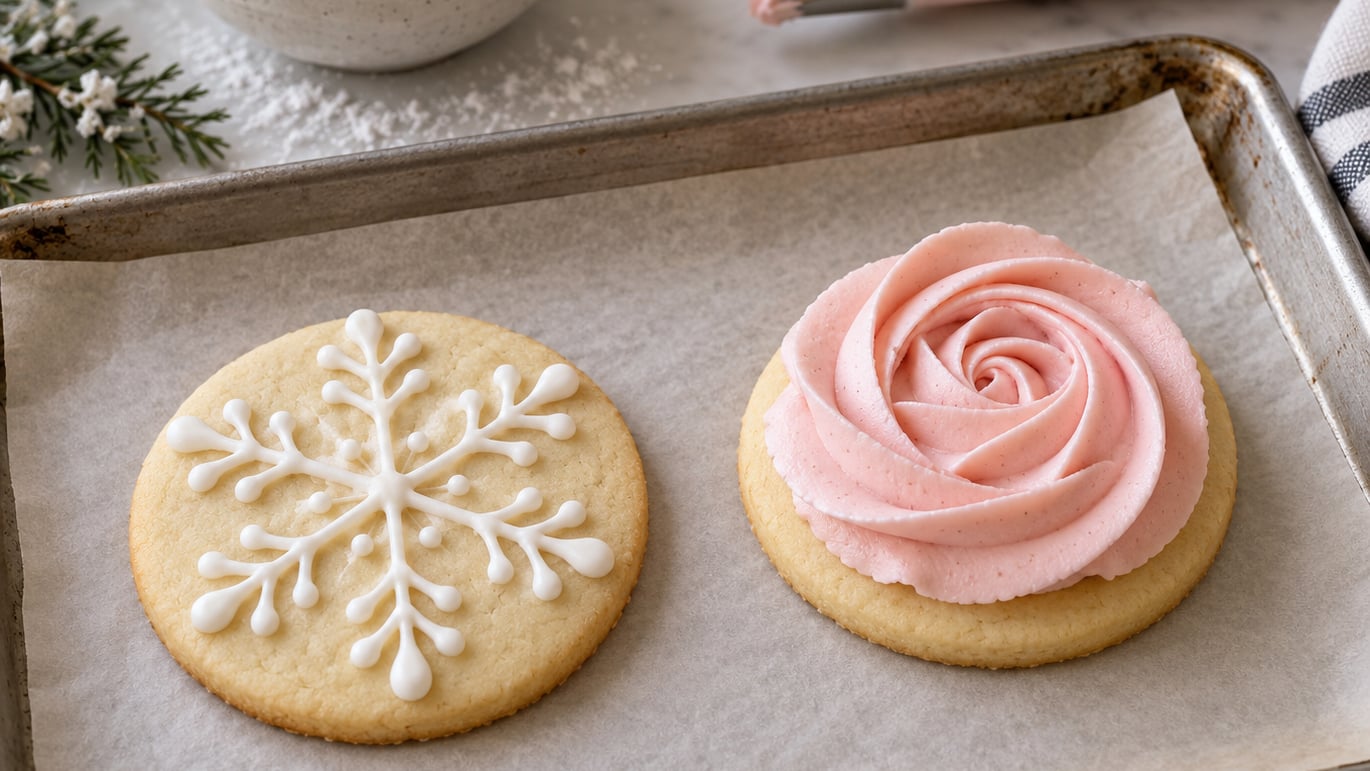
Royal icing vs buttercream on cookies comes down to what you need: royal icing dries hard for stacking and shipping, while buttercream stays soft for a creamy bite and faster decorating. Choose royal icing for holiday cutout platters, wedding favors, and gifts that need to travel; pick buttercream for casual parties, kid-friendly decorating, and any cookie you plan to eat the same day.
Table of Contents
- Royal Icing vs Buttercream on Cookies at a Glance
- What Royal Icing Is and How It Behaves on Cookies
- What Buttercream Is and How It Behaves on Cookies
- Flavor and Texture on the Bite
- Look, Color, and Detail Work
- Drying Time, Stacking, and Transport
- Ease of Mixing and Piping for Beginners
- Storage, Make-Ahead, and Allergy Notes
- Which Should You Choose?
- Frequently Asked Questions
- Can you use buttercream on cutout sugar cookies?
- Does royal icing harden on cookies, and how long does it take?
- Which frosting is better for shipping decorated cookies?
- Can you pipe royal icing and buttercream with the same tips?
- Is royal icing or buttercream easier for kids to decorate with?
- How far ahead can you frost cookies with each type?
Royal Icing vs Buttercream on Cookies at a Glance
The table below covers the differences that actually matter when you are standing in the kitchen deciding what to mix.
| Feature | Royal Icing | Buttercream |
|---|---|---|
| Main ingredients | Powdered sugar, meringue powder or egg whites, water | Butter, powdered sugar, milk or cream, vanilla |
| Flavor | Sweet, almond-vanilla, slightly chalky | Rich, creamy, buttery |
| Texture on the bite | Hard shell, soft center as it dries | Soft, fluffy, melts in the mouth |
| Look | Smooth, matte, paintable surface | Soft swirls and ridges |
| Drying time | 1 to 24 hours depending on thickness | Stays soft, no dry time |
| Piping ease | Multiple consistencies, practice required | One bowl, one consistency, forgiving |
| Stacking and shipping | Stacks safely once dry | Smudges under weight and warmth |
| Best for | Cutouts, gifts, weddings, gingerbread houses | Cupcakes, casual trays, kid parties |
| Make-ahead window | 2 to 3 weeks stored airtight | 1 to 2 days at room temperature |
| Allergy watch | Egg-free if you use meringue powder | Dairy-based unless you swap the butter |
What Royal Icing Is and How It Behaves on Cookies
Royal icing is a sweet, glossy mixture made from powdered sugar whipped with meringue powder (or pasteurized egg whites) and a small splash of water. Bakers have used it for centuries to decorate cakes and cookies because it air-dries into a smooth, hard shell.
On a sugar cookie, royal icing behaves almost like edible paint. The first coat can be piped as a thin outline, then a thinner run of fillings, called flooding consistency, can be piped inside to fill the shape. As it dries, the surface turns matte and firm, leaving crisp edges and clean color separation.
Most recipes call for powdered sugar at a ratio near 2 cups per egg white or per 2 tablespoons of meringue powder. You tune the consistency by adding water a little at a time until a ribbon of icing disappears back into the bowl in about 10 to 15 seconds. That test is what bakers call the 10-second or 15-second rule.
What Buttercream Is and How It Behaves on Cookies
Buttercream frosting on cookies is the American style most home bakers know: butter beaten with powdered sugar, a splash of milk or cream, vanilla, and a pinch of salt. There are other buttercreams (Swiss, Italian, French), but the fluffy American version is the one you usually see on cookies and birthday cakes.
On a cookie, buttercream behaves like soft frosting. It pipes in soft peaks and holds ridges from the tip. The texture stays creamy even after it sits for hours, which is part of its charm. Cookies frosted with buttercream taste like a small bite of cake.
A basic batch uses 1 cup of butter, 3 to 4 cups of powdered sugar, 2 to 3 tablespoons of milk or cream, and 1 to 2 teaspoons of vanilla. You whip it in a stand mixer for 3 to 5 minutes until it looks pale and fluffy. A few drops of gel food coloring mix in without thinning the texture the way liquid coloring can.
Flavor and Texture on the Bite
The flavor gap between the two frostings is the biggest reason home bakers pick one over the other.
Royal icing tastes intensely sweet, almost candy-like, with a clean vanilla or almond snap. The first bite cracks through the dried surface, which gives a satisfying crunch before the soft sugar cookie underneath shows up. Some bakers add a teaspoon of almond extract or a squeeze of lemon to round it out.
Buttercream tastes rich and creamy because of the butter. It coats the cookie with a soft, almost fudge-like layer that mingles with the dough rather than sitting on top. Reviewers note it is the frosting most kids ask for because the flavor feels familiar from cupcakes and birthday cakes.
If your family does not love very sweet frosting, buttercream is usually the friendlier choice. If a clean, crisp sweetness fits the project, royal icing wins.
Look, Color, and Detail Work
Royal icing gives you a flat, paintable surface that takes fine lines, sharp lettering, and flooded shapes. You can pipe a thin outline, flood the inside, then drop another color into the wet icing to create petals, dots, or geometric patterns. Once it dries, the colors do not bleed into each other, which is why cookie decorators use it for monograms, florals, and holiday scenes.
Buttercream gives a dimensional, painterly look. Soft rosettes, ruffled borders, and small buttercream flowers read more like a cake than a painted cookie. It is forgiving because mistakes blend in with the next swirl. Gel colors stay vibrant, though soft buttercream can pick up fingerprints and lose shape in a warm kitchen.
Match the angle to the occasion. Royal icing for stamped or picture-ready designs; buttercream for casual, homey trays where soft texture matters more than crisp edges.
Drying Time, Stacking, and Transport
Royal icing needs air to dry. A thin outline dries in 10 to 15 minutes, while a flooded cookie needs 6 to 12 hours before it is safe to touch, and up to 24 hours before it is fully hardened through. A dehydrator on the lowest setting can speed things up without cracking the surface.
Buttercream stays soft at room temperature. It does not need any drying time between layers, which is why decorating moves faster. The trade-off is that stacked cookies smudge under their own weight and any warmth softens the swirls.
For shipping and gift boxes, royal icing is the clear winner. A dried cookie can sit in a tissue-lined tin, travel in a car, and arrive looking the same. Buttercream cookies need to travel flat, cool, and close to the event.
Ease of Mixing and Piping for Beginners
Buttercream is the easier entry point. One bowl, one whisk or paddle, one consistency. You can switch tips and pipe rosettes, dots, and lines without testing the icing between layers. Most beginners finish a dozen cookies in under an hour.
Royal icing takes more setup. You usually mix two or three consistencies: a stiff one for outlining and flowers, a medium one for piping detail, and a thin flood consistency for filling. You need a scribe tool or toothpick to pop air bubbles, and you wait for each layer to dry before adding the next. Beginners often need a test cookie or two before the workflow feels natural.
Community discussions on r/cookiedecorating and r/AskBaking echo this: first-time decorators often start with buttercream, then move to royal icing once they want crisp designs or stacked gifts.
Storage, Make-Ahead, and Allergy Notes
Royal icing cookies keep the longest. Once the icing is fully dry, store them in an airtight container at room temperature for up to 2 to 3 weeks. Layer them with parchment or wax paper so the icing does not scuff.
Buttercream cookies keep for 1 to 2 days at room temperature before the frosting starts to crust or weep. The fridge firms the butter but can cause condensation on the surface, so most bakers leave them on the counter unless the kitchen is hot.
For allergies, royal icing made with meringue powder is egg-free, which helps in classrooms. Buttercream swaps easily with vegan butter or shortening for dairy-free needs. Either icing can be made without nuts, but always check labels on flavorings and mix-ins if allergens are a concern.
Which Should You Choose?
Match the frosting to the occasion rather than the other way around.
Choose royal icing for holiday cutout platters, edible gifts, wedding and shower cookies, gingerbread houses, or any cookie that needs to stack, ship, or sit on display. It is also the right pick when you want stamped monograms, fine lines, or detailed florals.
Choose buttercream for birthday party trays, kid decorating sessions, cupcakes and cookie sandwiches, last-minute bakes, and any batch you plan to eat within a day or two. It is also the friendlier choice when flavor matters more than a glossy finish.
For many home bakers, the answer is to learn both. Use royal icing for the cookies that travel and buttercream for the cookies you serve right away.
Frequently Asked Questions
Can you use buttercream on cutout sugar cookies?
Yes. Buttercream works well on cutout sugar cookies for soft, cake-like frosting. It does not dry hard, so the cookies are best eaten within one to two days and should not be stacked. Use a piping bag with a round or star tip for clean shapes.
Does royal icing harden on cookies, and how long does it take?
Royal icing air-dries to a hard, matte shell. A thin outline dries in 10 to 15 minutes, while a flooded cookie needs 6 to 12 hours before it is safe to touch and up to 24 hours for a full cure through the icing. Cool, dry air and a fan speed things up.
Which frosting is better for shipping decorated cookies?
Royal icing is the better choice for shipping. Once fully dry, the icing protects the cookie surface and the cookies stack safely in tissue-lined tins. Buttercream smudges under weight and softens in warm trucks, so it is not a good fit for long shipping.
Can you pipe royal icing and buttercream with the same tips?
Most piping tips work for both, though the results differ. Round tips 1 to 3 give crisp royal icing detail; the same tips give soft buttercream lines. Star tips like 1M make fluffy buttercream rosettes and royal icing borders. Use couplers so you can swap bags between batches.
Is royal icing or buttercream easier for kids to decorate with?
Buttercream is easier for kids. It uses one forgiving consistency, so mistakes blend into the next swirl, and there is no waiting between layers. Royal icing rewards patience and steady hands, which can frustrate younger decorators.
How far ahead can you frost cookies with each type?
Royal icing cookies can be made 2 to 3 weeks ahead and stored airtight once fully dry. Buttercream cookies keep for 1 to 2 days at room temperature before the frosting starts to crust or weep, so plan to frost them the day before or the morning of serving.