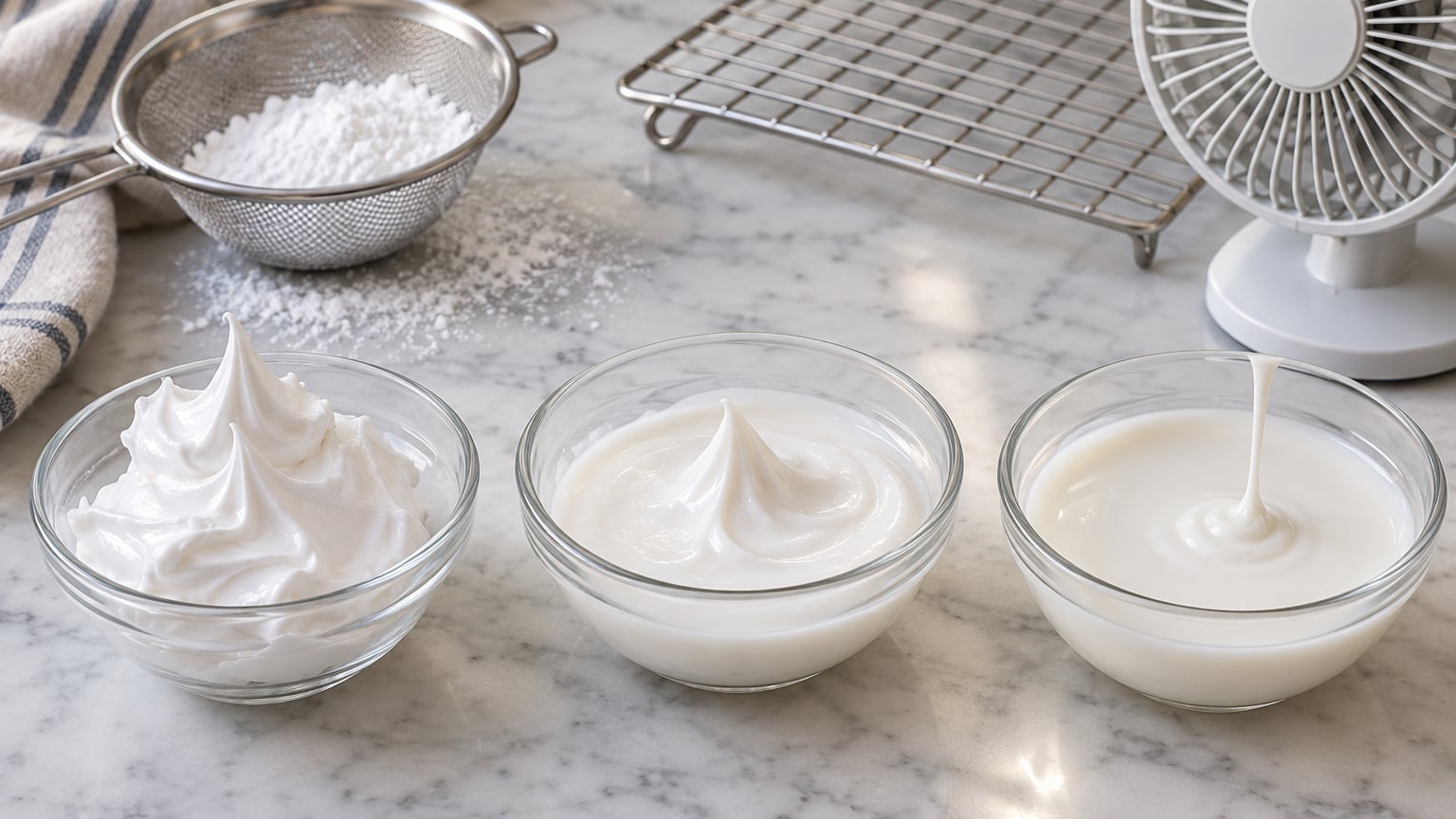
Royal icing stays soft when the sugar-to-liquid ratio is off, the meringue powder is old or under-measured, the room is humid, or the icing is applied too thick. The first three fixes are simple: recheck the recipe, move to a drier room, and spread thinner layers. If the batch still resists after that, the meringue powder is usually the culprit.
Table of Contents
- The Quick Answer
- How Royal Icing Is Supposed to Harden
- The Most Common Reasons Royal Icing Will Not Harden
- Room Temperature and Humidity: The Hidden Problem
- Recipe Ratios That Actually Harden
- How to Fix a Batch That Will Not Set
- Drying and Storage Tips for a Hard Finish
- When the Problem Is the Cookies, Not the Icing
- Frequently Asked Questions
- How long does royal icing take to fully harden?
- Can I make royal icing harden without meringue powder?
- Why is my royal icing still soft after 24 hours?
- Does putting royal icing in the fridge help it harden?
- What is the difference between royal icing drying and hardening?
- Can I use a fan or dehumidifier to make royal icing set faster?
The Quick Answer
Royal icing fails to harden for four main reasons: too much liquid in the mix, weak or expired meringue powder, a humid room, and icing spread too thickly. Start by rechecking your recipe against a trusted ratio, then move the drying cookies to a drier spot with moving air, and pipe thinner coats. After those three fixes, replace your meringue powder if it has been open more than a year.
How Royal Icing Is Supposed to Harden
Royal icing hardens through a quiet bit of kitchen chemistry. Meringue powder contains dried egg-white proteins. Once you add water and whip, those proteins unwind and link together. Sugar crystals pack into the spaces between them. As the water evaporates, the protein-sugar matrix locks into a rigid shell.
Bakers describe three stages as icing dries. The first is a soft set, where the surface looks matte but a light touch still leaves a fingerprint; that arrives in roughly 1 to 2 hours at room temperature. The second is a medium set, where the icing holds a line but is not yet safe to stack; this usually takes 4 to 6 hours. The final stage is a hard set, where the icing snaps cleanly when you bite it and is fully dry to the center; that takes 6 to 12 hours for thin coats and up to 24 hours for thick flooding.
If your icing never reaches any of those stages, something in the mix or the room is working against the chemistry. The rest of this article walks through what that is, and what to do about it.
The Most Common Reasons Royal Icing Will Not Harden
Over the years I have watched a lot of decorators troubleshoot this exact problem, and the same handful of causes shows up over and over. Here they are in the order I would check them.
1. Too much liquid. A runny icing feels easier to spread, so it is tempting to thin until it pours. The catch is that every extra teaspoon of water has to evaporate before the icing sets. If your icing ribbons off the spoon like heavy cream, it is too wet to harden within a normal timeframe.
2. Not enough meringue powder. Meringue powder is the structural backbone. Recipes that skimp on it (often less than 2 tablespoons per 500g of powdered sugar) produce icing that dries on the surface but stays gummy underneath.
3. Old or expired meringue powder. Meringue powder loses potency over time, especially after the bag is opened. If yours has been sitting in the pantry for a year or more, it may not be whipping the proteins the recipe needs.
4. Butter, margarine, or extract substitution. Butter and oil repel water and disrupt the protein-sugar structure. Substituting butter for some of the meringue powder, or using oily extracts like coconut or almond in large amounts, can keep icing soft for days.
5. High humidity in the room. When the air is already holding a lot of moisture, water has nowhere to go. A kitchen at 75 percent humidity will take far longer to dry icing than one at 45 percent.
6. Thick application. A flooding layer thicker than about 3mm takes far longer to harden because the interior stays wet. Thin, even coats set quickly. Thick, generous coats do not.
7. Sealing cookies in a covered container too soon. Stacking or covering cookies before the icing is fully dry traps moisture underneath, which softens the surface and can even cause colors to bleed.
8. Contaminated or greasy cookie surface. Any butter or shortening on the cookie top blends with the icing and prevents a hard set. This one is sneaky because the contamination happened before you ever piped.
Room Temperature and Humidity: The Hidden Problem
Humidity is the variable bakers underestimate most. Royal icing dries by losing water to the surrounding air. If the air is already saturated, that water simply has nowhere to go. The ideal range for a decorating room is 68 to 72°F with 40 to 50 percent relative humidity. Inside that window, thin flood coats set in about 6 hours and full hard set follows within 12 to 18 hours.
When the kitchen is humid, a few practical moves help. Run a dehumidifier in the drying room if you have one. Air conditioning also pulls moisture out of the air while cooling it, which is why decorated cookies in air-conditioned bakeries often set faster. A small desk fan pointed across (not directly at) the cookies keeps air moving, which speeds evaporation without cracking the surface.
Two popular tricks do not help and sometimes hurt. The oven-with-only-the-light-on trick sounds gentle, but ovens hold residual moisture from previous bakes and most light bulbs are too cool to drive off humidity. The closed-up box trick, where you set cookies in a covered cake box to dry, is even worse: it traps moisture and keeps the icing soft.
Recipe Ratios That Actually Harden
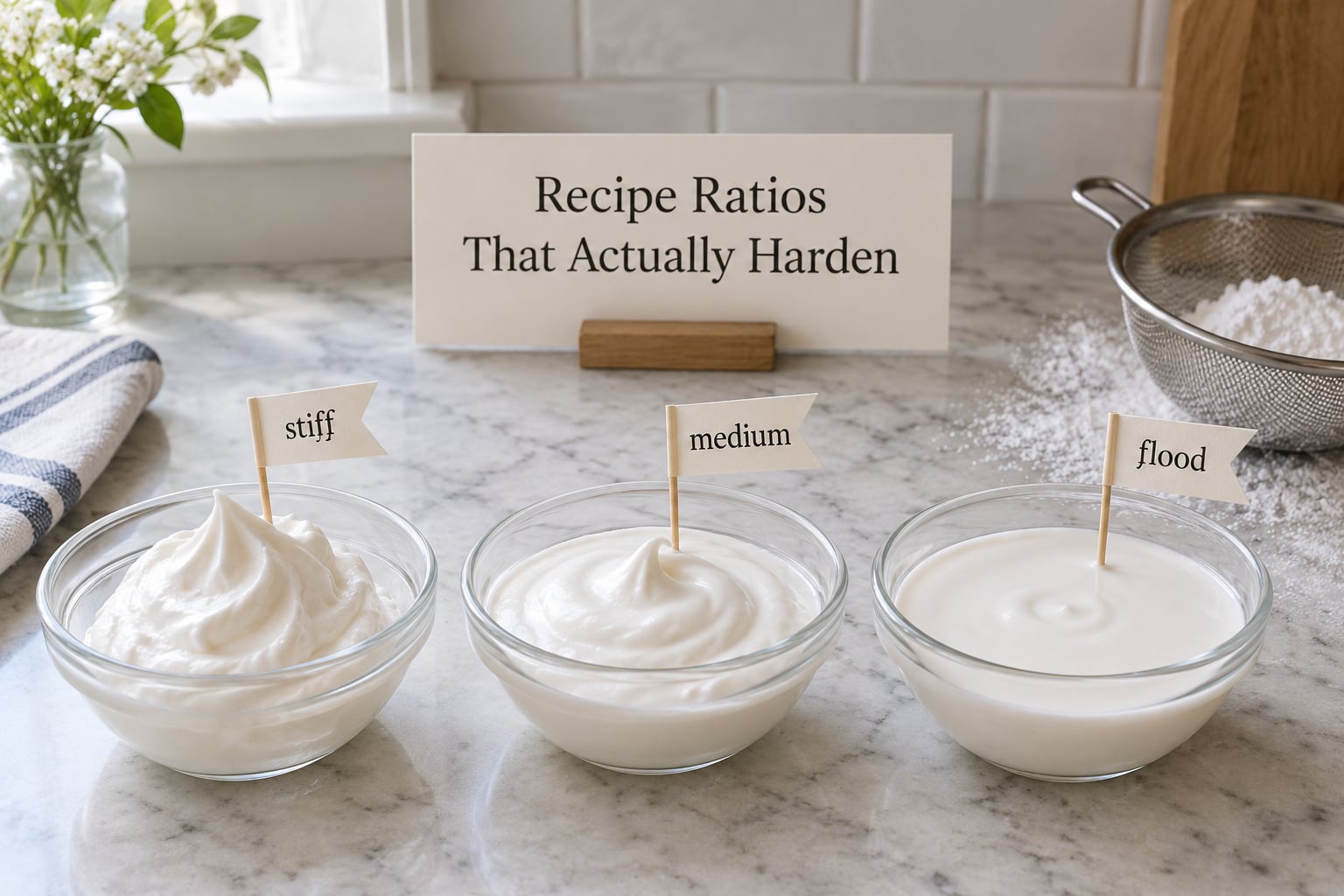
If the mix itself is under-powered, no drying method will save it. These are reliable ratios I keep coming back to, measured by weight because volume varies too much between brands of powdered sugar.
| Consistency | Powdered sugar | Meringue powder | Water | Best for |
|---|---|---|---|---|
| Stiff | 500g | 3 tbsp (about 30g) | 60 to 70g | Outlines, roses, structural piping |
| Medium | 500g | 3 tbsp (about 30g) | 80 to 90g | Details, lettering, mid-fill |
| Flood | 500g | 3 tbsp (about 30g) | 95 to 110g | Filling outlined cookies, smooth coats |
Notice the meringue powder stays the same across all three consistencies. Only the water changes. That is the part most home bakers get wrong: they add water to thin the icing without remembering that the protein load is fixed. If your flood icing is not setting, the answer is more water plus slightly more meringue powder, not just more water.
For reference, a teaspoon of water weighs roughly 5g. A tablespoon is about 15g. If you are measuring by volume, you can still use this table, but weigh your powdered sugar at least once to confirm the cup weight your recipe assumes.
How to Fix a Batch That Will Not Set
When a batch refuses to set, you have two real options: rescue it, or start over. The rescue path works when the icing is only slightly soft, not when it is genuinely soupy.
Step 1: Sift in additional powdered sugar, a tablespoon at a time, until the icing reaches the consistency you originally wanted. This thickens without changing the protein load much.
Step 2: Add a measured teaspoon of fresh meringue powder along with a teaspoon of water, then whip on low for 1 to 2 minutes. This refreshes the proteins if your current batch is old or has been sitting out for hours.
Step 3: Test a small puddle on a plate. It should flow out flat in 10 to 15 seconds and form a smooth surface. If it still peaks or stays thick, you need a touch more water. If it floods across the plate, you overcorrected and should add a bit more sugar.
Step 4: Re-whip the full batch for a final 60 seconds, then cover with a damp cloth and let it rest for 15 minutes before re-piping. This rest relaxes any air bubbles and gives the proteins time to fully hydrate.
Start over instead if the icing has been sitting out for more than 4 hours, has visible oil pooling on top, or smells off. At that point, no amount of rescue will return the structure you need.
Drying and Storage Tips for a Hard Finish
How you dry the cookies matters as much as how you mix the icing. A few habits I lean on:
Leave decorated cookies uncovered for at least 6 to 12 hours. A wire rack lets air circulate under the cookie, so the bottom dries along with the top. Flat trays trap moisture underneath and leave the base of the icing soft.
Run a fan on low, set a few feet away. Direct strong wind can crack thick flood coats, so aim the fan across the cookies, not at them. In humid climates, a dehumidifier in the same room is worth its weight in finished cookies.
Skip the fridge while icing is drying. Cold air holds less moisture, but a closed fridge actually has very high humidity. The temperature shift can also cause sugar crystals to bloom on the surface, leaving a cloudy finish.
Stack cookies only after 24 hours of full dry time. If you are in a humid climate, give them 36. When you do stack, slip a small silica gel packet into the storage tin to absorb any leftover ambient moisture.
For longer storage, royal-iced cookies keep in an airtight tin at room temperature for 2 to 3 weeks. They freeze well for up to 3 months if you layer them between sheets of parchment in a rigid container.
When the Problem Is the Cookies, Not the Icing
Sometimes the icing is fine and the cookies are sabotaging the finish. Three cookie-side problems come up most often.
First, grease. Butter-rich sugar cookies, especially those baked in pans that were not fully cleaned, leave a thin oily film on the surface. When icing lands on that film, it cannot bond properly. Pat the cooled cookie tops with a dry paper towel before piping; if the towel comes away shiny, the cookies are too greasy for royal icing straight out of the oven.
Second, soft dough. A very soft, under-chilled dough spreads in the oven and the tops end up almost greasy from butter migration. Chilling rolled dough for at least an hour before baking gives the cookies a firmer, drier top that takes icing well.
Third, underbaking. Cookies pulled out a minute or two early hold extra moisture, which slowly wicks into the icing and keeps it tacky. Bake until the edges are just golden and the centers look dry, then cool fully on the pan before moving to a rack.
For very soft or fragile cookies, a quick 5-minute rest in the fridge before you pipe also firms the surface just enough that the icing lays down cleanly instead of sinking in.
Frequently Asked Questions
How long does royal icing take to fully harden?
Thin flood coats usually reach a hard set in 6 to 12 hours at room temperature in a 40 to 50 percent humidity room. Thicker layers and detailed piping can take up to 24 hours. If the icing is still tacky after a full day, the recipe ratio or the room humidity is the likely problem.
Can I make royal icing harden without meringue powder?
Yes, raw or pasteurized egg whites plus a stabilizer like cream of tartar will work, since the egg-white proteins do the actual hardening. A vegan version using aquafaba (the liquid from a can of chickpeas) also hardens, though it stays slightly more delicate and benefits from a few extra hours of drying time.
Why is my royal icing still soft after 24 hours?
Soft icing after a full day usually points to under-measured meringue powder, humidity above 60 percent, or a contaminated cookie surface. Recheck the meringue powder level against a trusted ratio, run a dehumidifier in the drying room, and make sure the cookie tops are grease-free before piping.
Does putting royal icing in the fridge help it harden?
A fridge is not a good drying spot because the closed interior is humid and temperature swings can cause sugar bloom on the surface. Room-temperature drying with moving air, or a dehumidifier in a small room, will harden icing faster and more evenly than the fridge.
What is the difference between royal icing drying and hardening?
Drying is just water leaving the icing, which can happen on the surface long before the inside sets. Hardening is the full structural change where the protein and sugar matrix locks into a rigid shell. A cookie can feel dry on top and still be soft underneath, which is why bakers wait for a true hard set before stacking.
Can I use a fan or dehumidifier to make royal icing set faster?
Both work well. A small fan pointed across (not directly at) the cookies moves humid air away and speeds evaporation. A dehumidifier in the same room pulls moisture out of the air, which is especially helpful in humid climates. Together they can cut drying time by roughly a third.
Royal icing is forgiving once you understand what it needs: a balanced recipe with enough meringue powder, a dry room, and thin, even coats. Work through those three variables first whenever a batch refuses to set, and you will spend far less time rescuing soft cookies. For a deeper dive into the chemistry, the r/cookiedecorating community is a friendly place to compare notes and ratios.