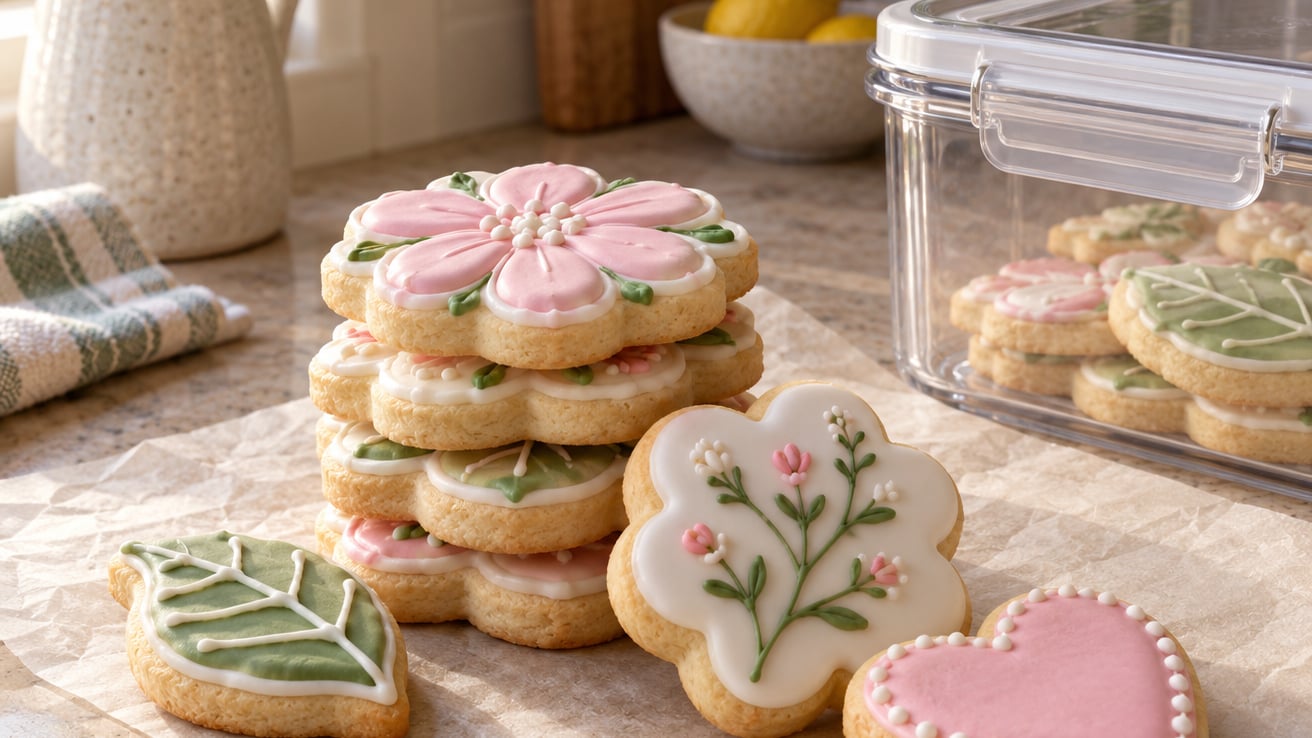
Cool decorated sugar cookies completely, then store them in a single layer inside an airtight container at room temperature for up to two weeks, or freeze them for up to three months. Royal icing must dry hard (6 to 24 hours depending on thickness) before the cookies touch each other, and a sheet of parchment or wax paper between every layer prevents dents, sticking, and color bleed. The whole process takes about 15 minutes of active work, and it works for holiday trays, party favors, cookie exchanges, and gift boxes alike.
I have stacked, frozen, shipped, and forgotten about decorated cookies more times than I care to admit, and the methods below are the ones that actually held up. Whether you finished a batch of Christmas sugar cookies at midnight or you are planning two dozen for a birthday party next weekend, here is the storage plan I trust.
Table of Contents
- What You Need
- Step-by-Step: How to Store Decorated Sugar Cookies
- Storage Times at a Glance
- How to Store Decorated Sugar Cookies by Icing Type
- How to Freeze Decorated Sugar Cookies
- How to Pack and Ship Decorated Sugar Cookies
- Common Mistakes and How to Fix Them
- Frequently Asked Questions
- How long do decorated sugar cookies last at room temperature?
- Should I refrigerate decorated sugar cookies?
- How do I keep decorated sugar cookies soft or crunchy?
- Can you vacuum-seal decorated sugar cookies?
- How can I tell if a stored decorated sugar cookie has gone bad?
- Can I store different icing types in the same container?
What You Need
Before you start stacking, gather a few basics. Almost everything is probably already in your kitchen, and the rest is cheap to pick up at a craft store.
- Fully cooled, fully decorated cookies. I mean fully. A warm cookie traps steam inside the container and turns royal icing gummy.
- Parchment paper or wax paper, cut into squares slightly larger than the cookies.
- An airtight container with a flat, rigid bottom. A metal cookie tin, a sturdy plastic tub, or a glass baking dish with a snap lid all work. Soft bags do not.
- Optional but helpful: food-safe silica gel packets for humid climates, and clean hands or food-safe gloves so fingerprints do not end up on the icing.
One rule covers every icing type: the decoration must be set to the touch before any two cookies meet. Royal icing needs 6 to 12 hours for thin flood coats and 12 to 24 hours for heavy details or piped borders. Fondant needs about 1 to 2 hours. Buttercream and cream cheese frosting technically count as “set” when they are no longer wet, which is usually 30 to 60 minutes in a cool room, but they stay soft, so stacking is risky. A thin glaze needs 2 to 4 hours.
Press the icing lightly with a clean fingertip before you close the lid. If your finger comes away clean and the surface feels hard, you are good. If it leaves a mark, give it more time. I learned this the hard way one Thanksgiving when I stacked a tray too early and ended up with a single cookie-shaped mosaic.
Step-by-Step: How to Store Decorated Sugar Cookies
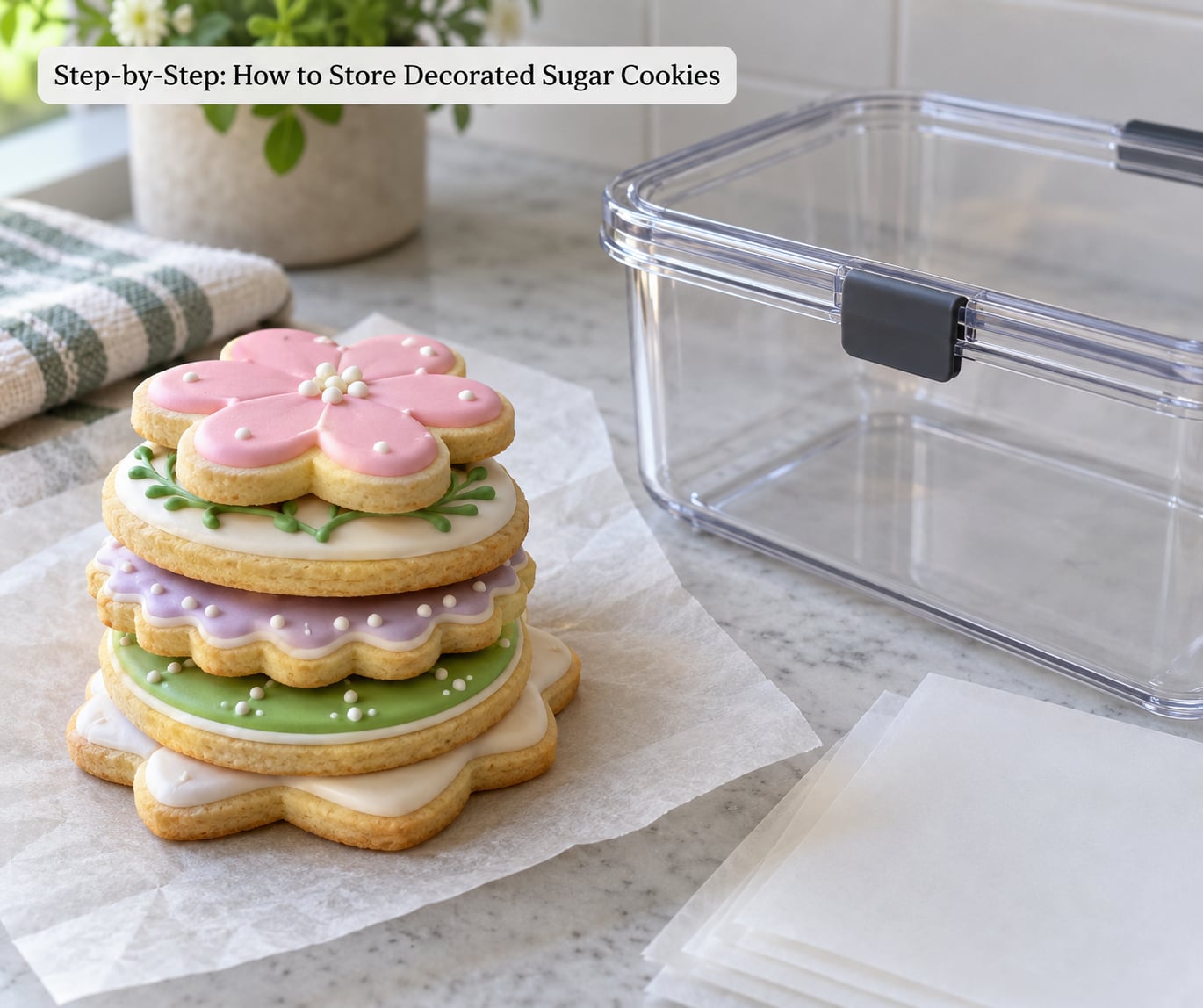
Follow these steps in order for the best results, whether you are storing at room temperature, in the fridge, or in the freezer. The first three steps are the same in every case.
1. Let the Icing Set Fully
Lay cookies on a cooling rack in a single layer and leave them uncovered for the full drying time. A fan pointed across them speeds things up, and a dehydrator on its lowest setting (around 95 degrees F) can cut royal icing dry time in half. Skip the oven, since the heat can melt butter-based dough and make royal icing crack.
2. Layer Cookies Between Sheets of Parchment
Place a square of parchment or wax paper on the bottom of the container, then set one cookie on top. Add another square, then another cookie. Never let two decorated surfaces touch each other. The parchment takes the pressure off the icing and stops color from one cookie bleeding into the next, which is the most common reason a red detail ends up turning a white background pink.
3. Choose the Right Container
Pick a rigid, airtight container that is just a little larger than the cookies themselves. You want a small gap of air, but not so much room that cookies slide around. For shaped cookies with tall piped details, a wider container like a sheet cake pan with a tall lid works better than a tight tin, because you can add an extra layer of parchment over the decorations to keep them from brushing the lid.
4. Store at Room Temperature in a Cool, Dry Spot
Snap the lid on and tuck the container into a pantry, cupboard, or closet away from sunlight, the stove, and the fridge. Room temperature storage is the best choice for royal icing, fondant, and glaze. Cookies stay fresh for 1 to 2 weeks this way, and the icing stays crisp. Keep the container out of the reach of pets and small children, and never set it on a windowsill, because direct sun softens royal icing and fades food coloring.
5. Refrigerate Only If You Must
Most decorated sugar cookies should not go in the fridge. The cold air pulls moisture into the icing, which causes sweating, color bleed, and a tacky surface when the cookies warm back up. The one exception is buttercream or cream cheese frosting, which has to be refrigerated for food safety. In that case, store them in a single layer in an airtight container, eat within 3 to 5 days, and let them sit on the counter (still in the container) for 15 to 20 minutes before serving so any surface condensation evaporates. Blot gently with a paper towel if you see beads of water.
Storage Times at a Glance
This table gives you a quick answer based on the icing you used. Use it as a sanity check before you start stacking.
| Icing Type | Room Temp (Airtight) | Refrigerator | Freezer |
|---|---|---|---|
| Royal icing | 1 to 2 weeks | Not recommended | Up to 3 months |
| Fondant | 1 to 2 weeks | Not recommended | Up to 3 months |
| Glaze (thin sugar icing) | 1 week | Not recommended | Up to 2 months |
| Buttercream | 1 to 2 days | 3 to 5 days | Up to 2 months |
| Cream cheese frosting | Not recommended | 3 to 5 days | Up to 1 month |
| Uniced (naked) cookies | 1 week in a cookie jar | 2 to 3 weeks | Up to 3 months |
These ranges are realistic for cookies that are stored correctly from the start. A cookie that was already a few days old before it was decorated will not last the full window.
How to Store Decorated Sugar Cookies by Icing Type
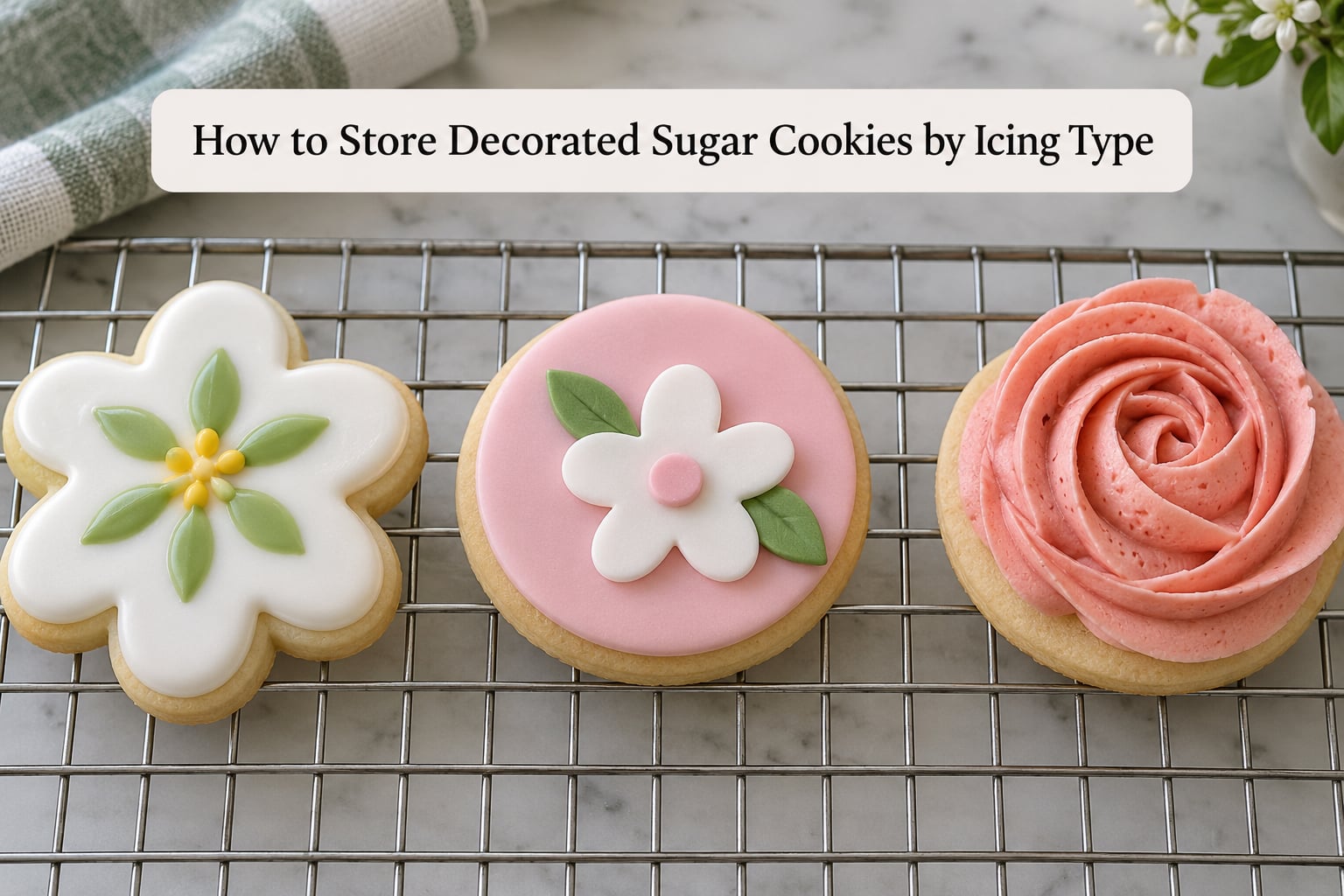
Every icing has its own personality, and the storage method that works for one will ruin another. Here is how to handle each one for the best results.
Royal icing dries rock hard, which makes it the easiest to store. Stack cookies with parchment between layers in an airtight container, and you can pile them four or five deep without damage. Color bleed is the main risk, so keep dark colors (red, black, deep blue) on their own tray or wrapped in an extra sheet of parchment. Community decorators on Cookie Connection note that royal icing made with meringue powder or pasteurized egg whites stores a little more reliably than raw-egg versions.
Fondant can sweat badly in the fridge, so room temperature in a cool, dry room is the way to go. Skip the fridge entirely. If your kitchen runs warm, a single layer in a tin with a loose lid keeps condensation from forming. Avoid touching the fondant surface when you transfer cookies, since finger oils make the shine dull.
Buttercream and cream cheese frosting need the fridge for food safety, and they will weep a little as they warm up. Store them in a single layer, blot any moisture with a paper towel before serving, and plan to eat them within a week. If you know the cookies will be out at room temperature for more than two hours at an event, keep them chilled until the last minute.
Thin glaze is fragile until it is fully set, and it can stick to parchment if you press it on too soon. Use a nonstick silicone baking mat underneath while drying, then transfer with a thin offset spatula to the storage container with a fresh piece of parchment on top.
Naked or undiced cookies go stale within a few days at room temperature. Eat those first, or freeze them well wrapped and decorate after thawing for a fresher bite.
How to Freeze Decorated Sugar Cookies
Freezing is the best way to get ahead on holiday trays or to save a batch when plans change. The trick is to keep condensation from forming on the icing surface, since that is what causes the dreaded color bleed and sticky patches.
Start by laying the cookies on a parchment-lined sheet pan in a single layer, not touching. Slide the pan into the freezer for about 1 hour, uncovered, until the cookies are firm to the touch. This flash freeze keeps the icing from sticking to the next layer of parchment.
After the cookies are firm, wrap each one individually in plastic wrap, or stack a few with parchment between layers and slide the whole stack into a heavy-duty freezer bag. Press out as much air as you can before sealing, and label the bag with the date. Cookies keep well in the freezer for up to 3 months, and most decorators say the quality is best in the first 6 to 8 weeks.
To thaw, leave the cookies in their sealed bag on the counter. Do not open the bag for 20 to 30 minutes, or until the surface no longer feels cold. Trapping the air in the bag while the cookies warm up prevents condensation from settling on the icing. Once they are at room temperature, open the bag, let any remaining moisture evaporate for another 10 minutes, and then move them to a serving tray.
How to Pack and Ship Decorated Sugar Cookies
Shipping decorated cookies is a little more work, but it is the only way to send a homemade gift that still looks homemade when it arrives. The goal is no room to move and no sudden temperature swings.
Wrap each cookie snugly in plastic wrap or a small piece of food-safe cellophane. Place them in a rigid box that fits the cookies closely, with parchment or wax paper between any stacked layers. Fill empty space with crumpled parchment, tissue paper, or even clean shredded paper, so the cookies cannot shift during transit.
Set that box inside a slightly larger shipping box and cushion all six sides with bubble wrap or packing paper. Ship early in the week (Monday or Tuesday) so the package does not sit in a warm warehouse over the weekend, and consider an insulated mailer or cold pack in summer months. Royal icing holds up to the mail best. Buttercream and cream cheese frosting should not be shipped without refrigeration, and fondant can soften in extreme heat.
Expect 2 to 3 days in transit for the best results, and tell the recipient the package is on the way so they can grab it the day it arrives. Cookie Connection bakers who ship for military care packages and large events have used this exact method to send cookies across the country with very few breakages.
Common Mistakes and How to Fix Them
Most cookie storage problems come down to a handful of repeat offenders. Here is what to watch for, and how to fix each one before it ruins the batch.
Stacking before the icing is dry. The fix is simple: wait. Royal icing needs at least 6 hours for a thin flood coat and up to 24 hours for piped details. Press the surface with a clean finger. If your finger comes away clean, you are good. If not, give it more time.
Using soft plastic bags. A zip-top bag presses against the icing and leaves dents, sticks, and stripped patterns. Switch to a rigid container with a flat bottom and a loose-fitting lid, or layer parchment over the top cookies before closing the lid.
Refrigerating royal icing or fondant. Cold air plus the moisture in a fridge equals sweating, color bleed, and a sticky surface. The fix is to leave these cookies at room temperature in an airtight container. Only refrigerate buttercream or cream cheese frosting.
Freezing warm cookies. Warm cookies create steam inside the bag, and that moisture freezes onto the icing as a layer of frost. Always cool the cookies completely to room temperature first, then flash freeze on a sheet pan before bagging them.
Storing cookies near strong-smelling food. Sugar cookie dough soaks up odors from onions, garlic, and spices surprisingly fast. Keep the storage container in a closed pantry or a separate cupboard, not next to the stove or in the fridge door.
Skipping the parchment. Without a barrier, the icing on one cookie will glue itself to the bottom of the next one. The parchment or wax paper sheet between every layer is non-negotiable, even for “fully dried” royal icing.
Vacuum sealing decorated cookies. The pressure of a vacuum sealer can crush delicate piping and pull moisture out of the cookie. If you want a tighter seal, use a heat sealer on a bag of parchment-wrapped cookies instead, or just press the air out of a heavy-duty freezer bag by hand.
Frequently Asked Questions
How long do decorated sugar cookies last at room temperature?
Decorated sugar cookies stored in an airtight container at room temperature stay fresh for 1 to 2 weeks, depending on the icing. Royal icing and fondant both hold up well for the full two weeks if the cookies were fully dry before stacking. Glaze is good for about one week, and naked cookies start to stale after a few days.
Should I refrigerate decorated sugar cookies?
Most decorated sugar cookies should not be refrigerated. The cold air pulls moisture into royal icing, fondant, and glaze, which causes sweating, color bleed, and a tacky surface once the cookies warm up. The exception is cookies frosted with buttercream or cream cheese frosting, which need refrigeration for food safety and keep for 3 to 5 days in a single-layer airtight container.
How do I keep decorated sugar cookies soft or crunchy?
For soft cookies, add a slice of plain white bread to the airtight container and seal the lid. The bread releases moisture slowly and keeps the cookies chewy. For crunchy cookies, skip the bread and store them in a container with a loose lid, or leave the lid slightly cracked for the first hour so any remaining steam escapes.
Can you vacuum-seal decorated sugar cookies?
A standard countertop vacuum sealer is risky for decorated cookies, because the pressure can crush piped details and squeeze moisture out of the cookie itself. If you want a tighter seal for shipping or freezer storage, wrap each cookie in plastic wrap, layer with parchment, and use a heat sealer on the bag, or simply press the air out of a heavy-duty freezer bag by hand.
How can I tell if a stored decorated sugar cookie has gone bad?
Look for an off smell, any change in color beyond minor fading, a sticky or tacky icing surface that does not firm up after an hour at room temperature, or visible mold. Cookies that taste stale, floury, or pick up odors from the fridge or pantry should be tossed. When in doubt, throw it out and decorate a fresh batch.
Can I store different icing types in the same container?
It is best to keep icing types in separate containers, because they store at different temperatures and humidities. Royal icing and fondant do well together in a single layer at room temperature, but buttercream and cream cheese frosting need the fridge. Mixing them in one container usually means one type will suffer.
Start with completely dry icing, layer cookies between sheets of parchment in a rigid airtight container, and keep them at room temperature for up to two weeks. For longer storage, freeze them in a single layer on a sheet pan first, then bag and thaw them sealed so no condensation forms on the icing. Skip the fridge for royal icing and fondant, save it for buttercream, and your decorated sugar cookies will taste and look as good on day fourteen as they did on day one.