Starting a cookie decorating business from home is one of the most realistic side hustles a baker can launch. You bake, decorate, and sell custom cookies for birthdays, weddings, and holidays, all from a residential kitchen under local cottage food rules. Most home bakers can be ready to take their first paid orders in 2 to 4 weeks once licensing and equipment are sorted. Difficulty is moderate, mainly because the legal side varies by state and the early marketing takes real effort.
If you can roll out sugar cookie dough, pipe royal icing, and stay calm during a 24-orders-due-Friday rush, you have the technical half already handled. The other half is paperwork, pricing, and getting your cookies in front of the right people. This guide walks through both halves in the order you’ll actually do them.
Table of Contents
- What You Need Before You Take Your First Order
- Step-by-Step: How to Start a Cookie Decorating Business From Home
- Common Mistakes New Home Cookie Decorators Make
- Tips to Grow Beyond Your First 10 Orders
- Frequently Asked Questions
- How much money do I need to start a cookie decorating business from home?
- Do I need a license to sell decorated cookies from my home kitchen?
- How much should I charge for decorated sugar cookies?
- Can I run a cookie decorating business from home in an apartment?
- How long does it take to start taking orders?
- What equipment do I need to decorate cookies at home?
What You Need Before You Take Your First Order
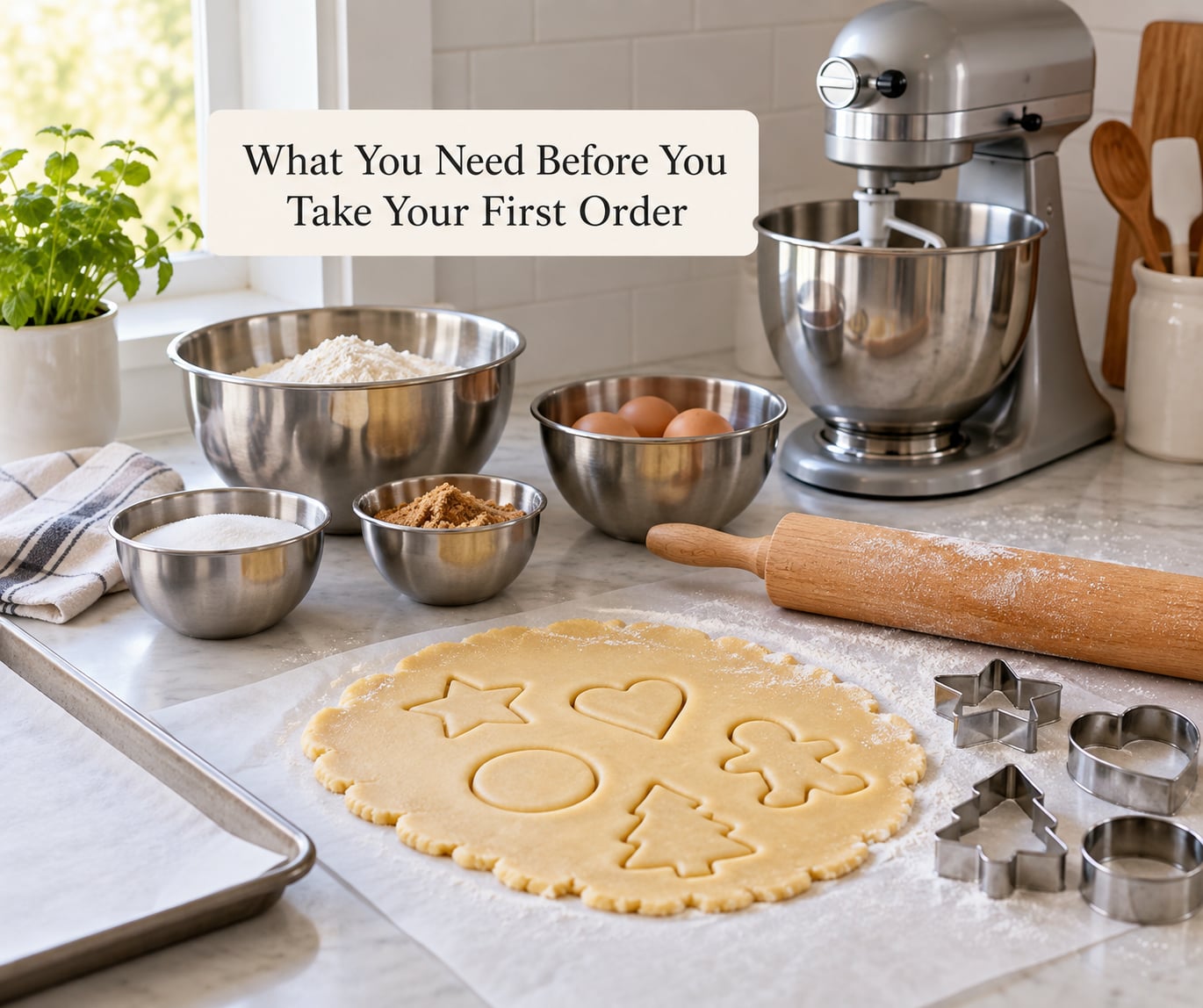
Before you post a single cookie photo, you need a kitchen that legally and practically passes as a home bakery. The specifics vary by state, but the core checklist is the same almost every new home cookie business starts with.
- A kitchen that meets local rules. Most cottage food programs require a dedicated residential kitchen with running water, a separate or cleanable prep surface, and no pets in the food prep area during baking hours.
- Business registration basics. A sole proprietorship or LLC, an EIN if you form a corporation, and a registered trade name if you plan to operate under anything other than your legal name.
- Any required permits or licenses. A cottage food license, home food processor registration, or county health permit where your state requires one.
- Food safety awareness. A short food handler course is helpful even when not required, and reviewers on r/cookiedecorating repeatedly recommend it.
- Core decorating equipment. Half sheet pans, a heavy rolling pin, a set of cookie cutters in shapes you actually plan to sell, a stand mixer or hand mixer, piping bags, piping tips, a scribe or toothpick, and a small offset spatula.
- Ingredients for a tested menu. Flour, sugar, butter, eggs, vanilla, meringue powder or powdered egg whites, gel food coloring, and sprinkles you can reorder reliably.
- Packaging supplies. Cellophane bags or food-safe bakery boxes, branded stickers, and label space for an ingredients list plus allergen disclosure.
- A way to get paid. A Square reader, PayPal business account, or Venmo business profile for mobile orders, plus a simple order form.
Rules vary by state and county, so confirm your exact requirements with your state Department of Agriculture or local health department before you start advertising.
Step-by-Step: How to Start a Cookie Decorating Business From Home
This is the order that works. You can finish steps one through three in a weekend, bake your test batches during the week, and start taking orders by the following weekend if your state processing is quick.
Step 1: Check Your State and County Cottage Food Laws
Cottage food laws control what you can sell, where you can sell it, and how much revenue you can earn from your home kitchen. Some states allow decorated cookies under a cottage food permit, some cap the business at a low annual revenue, and a small number of states still don’t allow home-based food sales at all. Read your state Department of Agriculture’s cottage food page and then call the county health department if anything is unclear.
How to tell it worked: You can name your state’s revenue ceiling, label requirements, and which sales channels (farmers markets, online, wholesale) are allowed, off the top of your head.
Step 2: Register Your Business and Get Permits
Form a sole proprietorship or LLC through your state’s Secretary of State website. Apply for an EIN from the IRS only if you form a corporation or want to open a business bank account. Register a trade name (also called a DBA) if you want to operate under something other than your personal name. Where required, complete a cottage food license or home food processor application, pay the fee, and pass any kitchen inspection.
Fees vary; forum reports on cakecentral.com put some state permits around the low hundreds per year, but your own state’s fee may differ. Rules and rates change, so verify locally.
How to tell it worked: You have a documented business name, any required license or permit number, and a digital folder where every certificate is scanned.
Step 3: Set Up a Food-Safe Decorating Space
Pick one room or one zone of your kitchen as the decorating station. Keep pets out during baking hours, store flour and sugar in sealed containers, sanitize the counter before each session, and put icing tools in a closed bin between uses. Royal icing keeps in a sealed container in the fridge for roughly 2 weeks, and baked sugar cookies stay fresh for about a week in an airtight container, so your storage plan should match those timelines. USDA safe minimum internal temperatures apply to any cookie with a baked filling (165°F / 74°C for poultry-based fillings, 160°F / 71°C for ground meat, 145°F / 63°C for whole cuts and fish), even though most decorated cookies don’t reach those ingredients.
How to tell it worked: Your kitchen passes a self-inspection with no cross-contamination between raw ingredients and finished decorated cookies.
Step 4: Build a Starter Menu and Pricing Formula
Start with a tight 4 to 6 design menu, all of which use shapes you already own cutters for. Pricing follows a simple formula: total your ingredient cost per design, multiply by 3 to 4 to cover labor and overhead, then add an hourly labor rate in the $15 to $25 range. A dozen decorated sugar cookies commonly lands in the $36 to $60 range, but pricing varies by region and complexity.
Write every price down with the cost breakdown. Each menu item should have a documented price that covers ingredients, labor, packaging, and a profit margin.
How to tell it worked: Every menu item has a written price, a known cost, and a profit margin above 30 percent.
Step 5: Set Up Ordering, Payment, and Packaging
Use a free Square or PayPal business account to take card payments, plus a Google Form or Squarespace order form for the order details. Set a minimum lead time of 7 to 14 days for custom designs so you have time to bake, decorate, dry, and package without cutting corners. For packaging, use food-safe cellophane bags or bakery boxes, a branded sticker, and a label that lists every ingredient and a “made in a home kitchen” disclosure where required.
How to tell it worked: A test order can be placed, paid, and fulfilled end to end without a single back-and-forth email.
Step 6: Photograph, Post, and Take Your First Orders
Photograph cookies near a window with a plain white or wood background, and never a handout piece. Post to Instagram and a Facebook local group, ask family and friends to share, and announce to your network with a clear opening-week discount on a small order (a dozen cookies). A typical first customer order is a birthday set of 12 cookies around $48, depending on your design and region. Don’t discount past your first 10 orders, because underpricing early is the fastest way to burn out.
How to tell it worked: Your first paying order is placed at full price without you having to chase it down.
Common Mistakes New Home Cookie Decorators Make
Almost every new home cookie business trips over the same handful of pitfalls. Here’s what to skip and the fix for each one.
- Skipping the cottage food law check. Reviewers on r/cookiedecorating keep flagging this. Fix: confirm with your state and county before you advertise, and keep the paperwork in your files.
- Underpricing to compete with grocery bakeries. Grocery bakery cookies use cheaper icing and mass production. Fix: price from your formula, not theirs, and let the design quality do the talking.
- Taking on complex orders too early. A 3D wedding tower on day three is a recipe for disaster. Fix: stick to 4 to 6 tested designs until you’ve delivered at least 20 orders without issues.
- No lead time or “I need it tomorrow” syndrome. Royal icing needs hours to dry. Fix: require at least one week of lead time, and put it in your order form.
- Ignoring allergens and disclosures. A customer with a nut allergy can sue if a label is wrong. Fix: list every ingredient, mark common allergens, and add a “made in a home kitchen” line where required.
Tips to Grow Beyond Your First 10 Orders
Once the first 10 paid orders are out the door cleanly, the playbook shifts from setting up to scaling up. These are the moves that actually move the needle.
- Batch your dough in big mixes and freeze rolled, cut cookies on a sheet pan. Decorating from frozen cuts hours off your week.
- Skip the projector until you have demand. Piping bags and a steady hand cover almost every beginner design.
- Run holiday preorders for Valentine’s Day, Easter, Mother’s Day, and Christmas. Prepayment protects your cash flow and your time.
- Collect emails from day one. An email list beats an algorithm change every time, which is a tip that comes up in cookie business Facebook groups again and again.
- Ask every happy customer for a tagged photo. User-generated content is your best marketing asset.
- Keep current on cottage food law updates. Rules change, and the bakers who recheck their state page every quarter don’t get blindsided.
Rates and rules vary by region and change over time, so bookmark your state’s cottage food page and revisit it every few months.
Frequently Asked Questions
How much money do I need to start a cookie decorating business from home?
Most home bakers can start with around 200 to 500 dollars in equipment and supplies. Covers a stand mixer, cookie cutters, sheet pans, royal icing tools, sprinkles, and your first batch of packaging. Permits and licenses add to that, and the fee varies by state, so confirm locally before budgeting.
Do I need a license to sell decorated cookies from my home kitchen?
It depends on your state and county. Many states require a cottage food license or home food processor registration. Some states allow direct sales without a permit up to a revenue cap. Check your state Department of Agriculture site, then call your county health department to confirm.
How much should I charge for decorated sugar cookies?
A common range is 3 to 5 dollars per cookie, which puts a dozen at 36 to 60 dollars depending on complexity and region. Price from a formula that covers ingredients, labor at 15 to 25 dollars per hour, packaging, and a profit margin above 30 percent.
Can I run a cookie decorating business from home in an apartment?
Often yes, but check your lease, HOA, and local zoning first. Many leases ban commercial activity, and HOAs can add restrictions. Some cities restrict home food businesses in apartment buildings, so a quick call to your property manager and your city zoning office saves headaches later.
How long does it take to start taking orders?
Most bakers are ready for their first paying order in 2 to 4 weeks. Week one covers legal research, registration, and equipment. Week two covers recipe testing and photography. Week three is your soft launch. Permit processing times vary, so build buffer into your timeline.
What equipment do I need to decorate cookies at home?
Start with half sheet pans, a heavy rolling pin, a stand or hand mixer, cookie cutters, piping bags, piping tips, a scribe or toothpick, gel food coloring, and airtight storage containers for royal icing. A projector is a later upgrade once you have steady demand.
Start with the legal check this week, not after you’ve baked your first sample set. Order your first batch of packaging, photograph three of your best cookies by a window, and post a soft-launch order form to your closest circle. Once your first paid order lands at full price, you’ll know the business works.